
Joint custody in California does not automatically mean that a child spends exactly half their time with each parent. Joint legal custody concerns shared decision-making, while joint physical custody concerns the time a child spends in each parent’s care. The court order determines how those responsibilities and parenting time work.
For parents separating in Westlake Village and the surrounding communities, the practical questions often matter more than the label: Who chooses the school? What happens on holidays? Can one parent schedule treatment without asking the other? A clear parenting plan should answer those questions.
What Does Joint Custody Mean in California?
California distinguishes between two forms of shared custody:
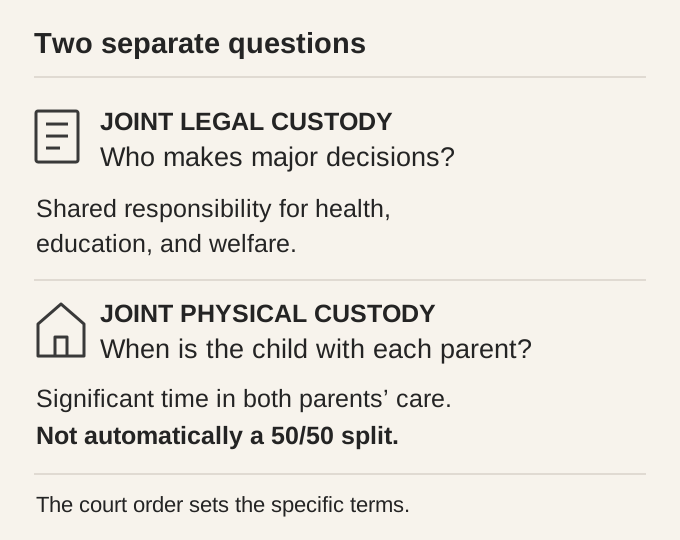
Under California Family Code section 3003, joint legal custody means both parents share decision-making rights and responsibilities. Section 3004 defines joint physical custody in terms of significant periods of physical custody, not a fixed percentage.
An order may combine joint legal custody with a schedule under which the child lives primarily with one parent. To understand your arrangement, read both the custody provisions and the parenting-time schedule.
Does California Require a 50/50 Parenting Schedule?
No. Joint physical custody does not, by itself, require equal time.
For example, a child might spend more school nights with one parent because of the distance between homes, while spending substantial weekends and vacation time with the other. Whether that arrangement is appropriate depends on the child’s needs and the circumstances.
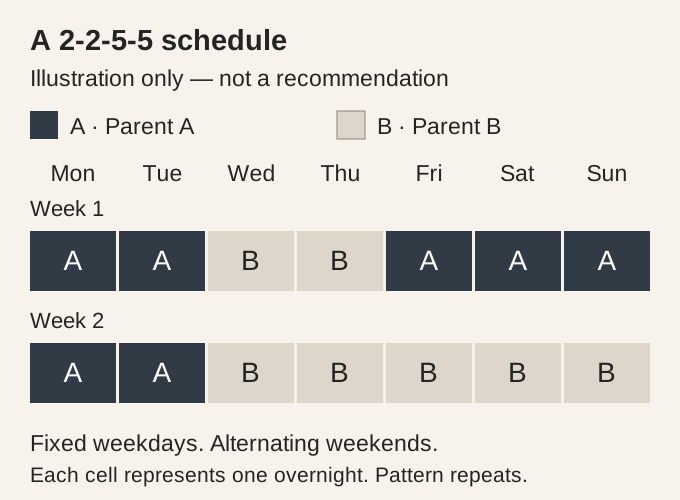
Equal-time schedules are another possibility. Examples include alternating weeks or a 2-2-5-5 schedule, in which each parent has two fixed weekdays and the parents alternate extended weekends. Neither arrangement is a universal recommendation.
Before proposing a schedule, consider:
- The child’s age, health, and daily routine.
- Travel time between each home and school.
- Each parent’s availability for school pickups and care.
- How frequently the child would change homes.
- Any safety concerns affecting contact or exchanges.
The goal is a workable plan for the child, not a particular percentage for its own sake.
Which Decisions Require Both Parents’ Agreement?
Joint legal custody does not mean parents must consult each other about every meal, bedtime, or ordinary activity.
However, important decisions may require mutual agreement. Depending on the order, these can include school enrollment, nonemergency medical treatment, counseling, or certain extracurricular activities.
Family Code section 3083 requires a joint legal custody order to specify when both parents’ consent is necessary and the consequences of failing to obtain it. In other circumstances, either parent may act alone, subject to the order’s terms. Joint legal custody also does not authorize actions inconsistent with the physical custody order.
That makes the wording important. Before changing a school or committing a child to an activity that affects the other parent’s time, check what the order requires.
If the order leaves an important issue unclear, seek legal advice rather than assuming that silence gives either parent unrestricted authority.
What Should a Joint Custody Parenting Plan Include?
A useful parenting plan explains how the arrangement will function during an ordinary week—and when something changes.
The California Courts’ parenting guidance recommends addressing where children will live, when they will see each parent, and how they will be cared for.
Useful provisions include:
- The regular schedule: School days, weekends, pickup times, and overnight arrangements.
- Holidays and school breaks: Which schedule takes priority when a holiday overlaps with a regular parenting day.
- Transportation: Who handles exchanges and where they occur.
- Communication: How parents share school notices, medical information, and scheduling requests.
- Decision-making: Which matters require agreement and how disagreements will be addressed.
- Schedule changes: How much notice parents should give and how they confirm an agreed adjustment.
For example, “alternate holidays” may leave parents disagreeing about when a holiday begins. Specific start and end times reduce that uncertainty.
What If the Other Parent Disagrees With Joint Custody?
A disagreement does not automatically determine the outcome.
Family Code section 3080 establishes a presumption favoring joint custody when both parents agree, subject to the statutory best-interest requirements. That is not a blanket rule requiring joint custody or equal time in every contested case.
If parents cannot agree, the judge decides based on the child’s best interests and applicable law.
A useful proposal should explain how the arrangement serves the child: how school transportation will work, how care will be provided, and how the plan supports stability. Focus on specific facts rather than broad accusations about the other parent.
Our guide to the best interest of the child in California explains that broader decision-making standard.
What If There Has Been Domestic Violence?
Shared parenting is not an obligation to accept an unsafe arrangement.
Domestic violence can affect both legal and physical custody. California has special rules, including Family Code section 3044, that may restrict an abusive parent’s ability to receive custody.
Depending on the circumstances, orders may include supervised visitation, protected exchanges, or other safeguards. The California Courts’ domestic violence guidance explains that safety concerns can also justify orders allowing no visitation.
If abuse or coercive control is involved, raise those concerns before agreeing to a parenting plan. General advice about cooperation may not be appropriate for your situation.
Preparing for a Joint Custody Discussion
Before meeting with an attorney or discussing a proposed plan, gather:
- Any existing custody orders.
- Your child’s school and activity calendars.
- Both parents’ known work schedules.
- A realistic transportation plan.
- Specific examples of recurring scheduling or decision-making problems.
Separate the issues you already agree on from those that remain unresolved. You may agree about school decisions but disagree about weekday overnights. Treating those as distinct questions can make the discussion more productive.
Build a Plan That Works Beyond the Custody Label
“Joint custody” is only the starting point. The schedule, decision-making provisions, and safety protections determine what the arrangement means for your family.
Mahdavi & Mahdavi Family Law serves parents in Westlake Village and throughout Ventura and Los Angeles Counties. If you are preparing a parenting plan or reviewing an existing order, an attorney can help you understand its terms and identify issues that need clearer provisions.
This article provides general information about California law and is not legal advice for a specific case.
Related reading: legal versus physical custody · creating a custody agreement. For representation, see our joint custody services.